
Most safety professionals understand the risks associated with excessive workplace noise. What is less obvious is how noise and vibration exposure can affect workers long before symptoms become apparent.
A recent study published in the journal of Sound and Vibration examined occupational noise and vibration exposure reinforces an important lesson for manufacturers: hearing damage and other exposure-related injuries are often cumulative, difficult to detect in their early stages, and expensive to address once they occur. The findings serve as a reminder that effective hearing conservation programs require more than simply providing earplugs. They require ongoing assessment, monitoring, and the right protection for the environment.
The Hidden Cost of Noise Exposure
Research continues to show that occupational noise can negatively impact worker health and performance. One recent study found measurable hearing threshold changes among workers exposed to higher industrial noise levels, even when exposure remained below commonly accepted limits. The study also observed reduced work performance among workers in higher-noise environments.
For industrial facilities, that’s an important takeaway.
Hearing loss rarely happens overnight. Instead, it develops gradually through repeated exposure over months or years. By the time a worker notices a problem, the damage may already be permanent.
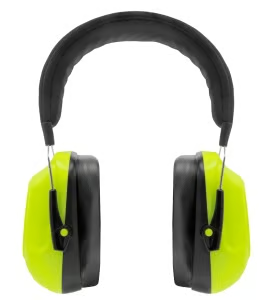
Noise is only part of the equation. Numerous studies have also examined the combined effects of workplace noise and vibration exposure, suggesting that workers exposed to both hazards may face increased risks compared to those exposed to noise alone.
That’s why proactive evaluation is so important. Safety managers and plant leaders need to understand where exposure risks exist, whether current hearing protection is adequate, and if employees are consistently using the right PPE for their work environment.
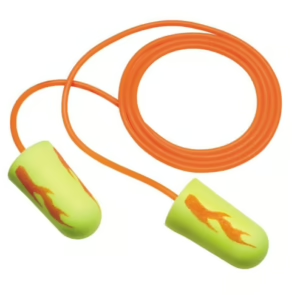
Agilix Solutions helps manufacturers address these challenges through Personal Protection Assessments that evaluate workplace hazards and identify opportunities to improve worker protection. Once exposure risks are understood, our team can recommend appropriate hearing protection solutions and other PPE designed to help employees work safely and comfortably. From earplugs and earmuffs to broader personal protection strategies, Agilix helps facilities build safety programs that protect workers while supporting compliance and operational performance.
Rather than waiting for hearing loss claims, injuries, or failed audits to reveal a problem, facilities can take a proactive approach that helps reduce risk and create a safer work environment for everyone on the plant floor.
Understanding OSHA Requirements
OSHA’s Hearing Conservation Standard requires employers to implement a hearing conservation program when employee noise exposures reach an 8-hour time-weighted average of 85 decibels (dBA). Monitoring, employee training, hearing testing, and hearing protection all become critical components of compliance at that point. Industry discussions among safety professionals frequently reference the 85 dBA action level as the threshold that triggers employee notification and hearing conservation requirements.
However, compliance should not be viewed as the finish line. The goal isn’t simply to meet regulatory requirements. It’s to protect workers from preventable hearing damage and long-term health effects.
Why NRR Matters

When hearing protection is required, selecting the right solution is critical.
Many organizations focus solely on a product’s Noise Reduction Rating (NRR), assuming a higher number automatically means better protection. In reality, proper fit, comfort, worker acceptance, and the specific workplace environment all play important roles in determining how effective hearing protection will be.
If hearing protection is uncomfortable or interferes with a worker’s ability to perform their job, compliance often suffers. Even high-rated protection may provide limited benefit if it isn’t worn correctly or consistently. That’s why hearing protection should be selected based on actual exposure conditions rather than assumptions.
The Value of Personal Protection Assessments
At Agilix Solutions, we help manufacturers take a proactive approach to workplace safety through Personal Protection Assessments.
These assessments help identify workplace hazards, evaluate employee exposure risks, and ensure workers are equipped with appropriate personal protective equipment for their specific tasks and environments.
For facilities concerned about noise exposure, an assessment can help answer important questions:
- Are employees adequately protected?
- Are current hearing protection solutions appropriate for actual exposure levels?
- Are there opportunities to improve compliance and worker comfort?
- Are there additional hazards that should be addressed?
While hearing protection is a critical focus, Agilix also offers assessments for hand protection, foot protection, and other PPE categories to help organizations build comprehensive safety programs.
Protect Your People Before Problems Develop
Hearing loss is permanent. Many vibration-related injuries are difficult to reverse once symptoms appear.
The most effective safety programs don’t wait for injuries, claims, or failed audits to identify risks. They evaluate hazards early, implement appropriate controls, and continuously assess whether workers have the protection they need.
If you’re unsure whether your facility’s hearing protection program is providing the level of protection your workforce requires, contact Agilix Solutions to schedule a Personal Protection Assessment. Our team can help identify exposure risks, improve PPE selection, and support a safer workplace for everyone on your team.